MAP OF THE MONTH - Battle of Britain, 1940 - 41
Armchair General has partnered with The Map as History, a company that produces outstanding animated maps with accompanying narration. Each month, a link to one of their animated maps will be featured on the ACG site. This month's map explores the Battle of Britain and "the Blitz," Adolf Hitler's air war 1940-41 that was intended to bring Britain to its knees.
Showing posts with label Blitz. Show all posts
Showing posts with label Blitz. Show all posts
Friday, August 5, 2016
MAP OF THE MONTH – Battle of Britain, 1940 – 41

Wednesday, August 12, 2015
Battle of Britain - 7 September 1940

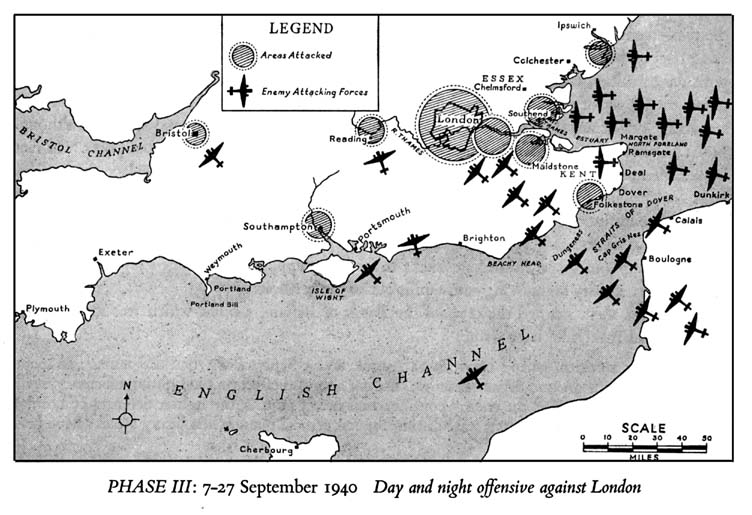
Most historians agree that the very nature of the Battle of
Britain changed on 7 September, with a shift away from the direct attack on
Fighter Command's airfields and the factories which produced its aircraft. The
change in targeting was driven by Goring and supported by Kesselring, who felt
that the anti-airfield campaign had run its course, and that Fighter Command
was finished. But Sperrle protested strongly, believing that Fighter Command
probably still had a thousand aircraft left, and wished to continue to scourge
the No.11 Group airfields. He was overruled.
But it would be a mistake to see the targeting of London as
necessarily marking a fundamental change in direction by the Luftwaffe. The aim
was still the destruction of Fighter Command, and the targeting of London
merely represented a switch to a target which the Germans felt was most likely
to draw the RAF's fighters into the air, where they could be destroyed. It was,
in the words of one German officer, the 'only target that Fighter Command would
give everything to defend.' That, at least, was Goring's theory, although it
did also mark an opportunity for vengeance following Bomber Command's raid on
Berlin on 25 August. And London was a vitally important target. It was Europe's
largest city, and was the capital city of a nation whose capital was of
unparalleled importance. It was the centre of Britain's economy, a major
industrial and port city, the seat of government and the home of the King.
Small wonder that it was a tempting target.
But just as Goring had rethought his battle plans, so too
did Dowding adjust his tactical thinking, and restructured his forces. By
coincidence, as the new phase of the Battle began, Dowding's reclassification
of his squadrons came into effect. Thereafter, the frontline squadrons in No.
11 Group were categorised as Class A squadrons, as were those units in Nos 10
and 12 Groups which Park might call on to reinforce his Group. Class B
squadrons were fully manned and fully established, and were ready to be called
into action, but might be lacking in combat experience or be suffering from a
degree of fatigue. Finally, Class C squadrons were those which had suffered
severe losses, and were being rested and re-equipped. Experienced survivors
from these units were taken (as soon as they were ready) to act as replacements
for pilots killed or wounded in the higher category units. This cut the link
between an individual pilot and his original unit, but ensured that newly
formed squadrons would have a core of combat-experienced veterans. Meanwhile,
Keith Park instructed his controllers and pilots to henceforth obey altitude
orders from Group, without making any personal interpretations of the heights
given. He did this to ensure that climbing fighters did not emerge below their
targets, but it caused delays and sometimes meant that the RAF fighters fought
the escorts instead of the bombers, which often flew slightly lower.
As if to deliberately confuse Fighter Commander, the
Luftwaffe began 7 September as it had begun many of the past days, with a
handful of reconnaissance sorties, but thereafter, the radar screens remained
clear and the plotting tables empty. The long delay seemed ominous. The Air
Ministry had already issued an 'Invasion Alert No. 1' (meaning attack imminent)
without having previously issued Alert Nos 2 and 3 (attack probable within two
and three days, respectively).
History records that the first raid counter was placed on
the plotting table at Bentley Priory at 1554, and that within minutes counters
representing many hundreds of aircraft were on the table. Goring had launched
virtually the full strength of KG 1, KG 2, KG 3, KG 26 and KG 76, together with
the Bf 110s of ZG 2 and the Bf 109Es of JG 2, JG 3, JG 51, JG 52, JG 54, I./JG
77 and I./ and II./LG 2. This colossal armada numbered 965 aircraft, stepped up
from 4268m to 7010m (14,000ft to 23,000ft) advancing along a 32.2km (20-mile)
front. Dowding and Park correctly guessed that only London could be the target
of such a vast force, and at 1617 11 fighter squadrons were ordered into the
air, with 21 units airborne by 1630. All available fighters raced towards the
capital, with no thought of standing guard over their airfields. The RAF
fighters were massively out-numbered by the German escorts, but tore into the
enemy with great ferocity. The German bombers aimed for the docks, but their
bombs fell over a wide area, from Kensington in the west but concentrated in
the East End, and doing as much damage to the densely packed terraces of
working-men's houses as to the docks, gasworks and power stations that were
also hit. The enemy bombers turned around and were all en route home by 1745,
albeit with huge gaps in the neat formations.
As the skies above London emptied of aircraft, the fight was
taken over by the firemen, who fought the spreading fires with a grim
determination. They fought to douse the burning buildings, the wooden-block
road surfaces on older streets and even the surface of the River Thames itself
(where floating liquid sugar ignited), all the while with the warehouses of
paint, oil, explosives and ammunition blowing up in terrifying explosions. But
it was not just the obviously dangerous materials that exploded - flour and
pepper were equally dangerous, and the conflagration threatened to become
self-sustaining as the fire sucked in oxygen from the surrounding streets.
Burning debris was tossed into the air like straw, setting new fires wherever
it landed. The London Fire Brigade classified a fire requiring 30 pumps as a
'Major' fire, yet in the early evening of 7 September, the Fire Brigade were
tackling nine fires which were officially rated as 'Conflagrations', in that
they required more than 100 pumps each. The largest was in the Surrey Docks,
where the fire was too large to classify, and where it was arbitrarily rated as
a 300-appliance fire.
At about 2010, the next wave of 318 German bombers began to
pour down tons of incendiaries. 306 civilians died in the bombing, and 1337
more were seriously injured in the City, with 142 more killed in the suburbs.
An enormous pall of smoke hung over the capital, and the fires burned on.
The first day cost Fighter Command dear, with the loss of 15
Spitfires (and four pilots) and 17 Hurricanes (with seven pilots). But the
Luftwaffe lost 38 aircraft, including 14 Bf 109s. The balance of attrition was
not very different from that suffered during the past weeks, although this
changed as the campaign wore on, and the onslaught on London soon became much
more costly to the attacker than to the defenders. And the blitz against London
lasted long after the Battle ended, bleeding the Luftwaffe white in the
process. The attacks continued on 76 consecutive nights, with only a single
exception. This was 2 November, when the weather was too poor to allow the
German bombers to operate. Perhaps most crucially, the Fighter Command
airfields, and the Chain Home stations were given precious respite by the switch
in targeting. Even the pilots themselves were rested when not actually in the
air over London. Squadrons spent whole days without coming to readiness, and
there was even time for newly arrived pilots to be taken on training and
familiarisation sorties -luxuries which would have been unthinkable only days
before. And, as in the phrase popularly used at the time, 'London could take
it'. Dowding was relieved by the switch in targeting, commenting that 'The
nearness of London to German airfields will lose them the war.' Churchill put
it in typically over-blown fashion. 'London is like some huge prehistoric
animal, capable of enduring terrific injury, mangled and bleeding from many
wounds yet preserving its life and movement.'
Wednesday, July 15, 2015
The beginning of the bombing of London Part I

On September 2 Reichsmarschall Göring had received the
Führer’s permission to begin large-scale day bombing of London (as well as
continuing night bombing). He arrived at the Pas-de-Calais on September 7 in his
luxurious private train to oversee the initial operation himself, and watch the
big formations of both his air fleets’ bombers and their escorting fighters
heading toward the white cliffs of Dover in the afternoon and on to London.
There were more than 300 bombers and 600 fighters, and the spectacle left most
people who saw it speechless; translated into electronic blips and squiggles on
a radar screen, it dismayed the RAF radar operators and controllers. This
immense raid—the largest so far in the history of air warfare—was far from
being a military secret. It was watched by Göring and his staff as it flew
overhead, in wave after wave, and was the subject of ecstatic reports on German
radio at home as it took place. The radio reports were artfully orchestrated by
Dr. Goebbels’s staff, with awe-inspiring music and sound effects. Göring
himself announced on the radio to the German people, “I have taken over
personal command of the Luftwaffe in its war against England.” Some people
noted the strange implication that he had not hitherto been in command; others
perhaps recalled that he had also promised that Berlin would never be bombed.
But the tone of the day in the German media was not only optimistic but
triumphalist, even orgiastic, in the tradition of Nazi propaganda. The British
radar operators, who were not listening to Radio Berlin, were at first
uncertain about what the Germans were planning to attack as they formed up in
such large numbers over Calais, and jumped to the conclusion that Kenley and Biggin
Hill would once again be the targets, as on previous days.
Fighter Command was, as a result, for once caught
flat-footed. Some of the confusion was the result of Park’s instructions to his
controllers two days earlier. Although his criticism of Leigh-Mallory was what
most of those who read the document noticed first, a second, and more important
subject was his dissatisfaction with the way controllers were positioning No.
11 Group’s fighter squadrons. To understand this, it is necessary to keep in mind
that radar had originally been an unreliable indicator of height. Radar
operators had therefore developed a habit of adding a few thousand feet to
their estimate of height because their radar sets generally indicated a height
they knew was too low. This technical problem had been largely corrected by
August 1940, but many of the operators were still adding on a couple of
thousand feet when they communicated their reading of the screen to the
controllers. Unfortunately, the fighter pilots themselves usually added on
another couple of thousand feet to the figure they were told, partly out of
experience and habit and partly because fighter pilots always want to seek the
advantage of height when attacking. The higher a pilot is, the better his view
of the enemy, and, of course, for a pilot height also equals speed—diving at
high speed on the enemy from above and behind was the best guarantee of making
a kill and escaping alive. Since it took time for a Spitfire or a Hurricane to
climb to a given altitude (about eleven minutes for the former to reach 25,000
feet), for obvious reasons the higher a squadron climbed, the longer it would
take to get there. The result was that squadrons were often too late to attack
the German bombers on their way in to their target and were attacking after the
bombs had been dropped. One complaint about Dowding and Park was that however
many German aircraft their pilots shot down, they were not doing enough to
prevent the Germans from dropping bombs in the first place.
This was related to the second consequence of climbing to a
higher altitude than was necessary—the higher British fighters climbed, the
more likely they were to meet German fighter escorts, some of which, despite
Göring’s order to stick close to the bombers, still flew well above them (which
was, of course, the only sensible way to protect them). This had the effect of
increasing fighter-to-fighter combat, and of decreasing attacks on the bombers,
which usually flew at least 4,000 to 5,000 feet lower. In theory, the Spitfire
squadrons should have been taking on the German fighters high up, the Hurricane
squadrons should have taken on the bombers lower down, since the Spitfire was
faster and could reach a higher altitude than the Hurricane. But in practice
this neat division of tasks was not happening, and the pilots were therefore
not taking full advantage of each plane’s particular characteristics—against
the bombers, the Hurricane was a sturdy and rock solid “gun platform”; but the
Spitfire was at its best at higher altitudes, where its speed, maneuverability,
and tight turning circle allowed it to fight with the Bf 109 on equal terms, or
better.
The beginning of the bombing of London Part II

Adding to Fighter Command’s difficulties that day, the
arrival of large numbers of barges in the Belgian ports had led many to
conclude that the German invasion might be imminent and that the big German
raid building up was the opening move, thus further deflecting attention from
what was actually happening. The German tactics were also designed to confuse
the British. The huge bomber force crossed the coast to the southeast of London
at a much higher altitude than usual, and at many different points, to confuse
the radar operators about the direction of the attack. Then it reassembled at
an altitude of about 16,000 feet and followed the Thames estuary directly
toward RAF Kenley, Biggin Hill, and Croydon, which were in any case what
Dowding and Park assumed were the targets; but having flown beyond Croydon it
suddenly turned back toward London’s East End. The approach to No. 11 Group’s
crucial Sector airfields was well protected, but the approach to London was
not, and it was too late to change that—at first, Park could put in only four
squadrons of fighters against the great mass of German bombers and fighters.
Even veteran fighter pilots were amazed when they came into view of these
aircraft. “It was a breathtaking sight,” one of them commented later. “You
couldn’t help feeling you’d never again see anything as remarkable as that.”
Another said, “I’d never seen so many aircraft,” and this was a common reaction
among the pilots, the radar plotters, and the observers on the ground. Nobody
had ever before seen so many aircraft gathered into one carefully organized
formation, so numerous that they seemed unstoppable. As five o’clock in the
afternoon approached, they were obviously headed for the East End of London,
with its docks, warehouses, factories, endless rows of small homes, and
sprawling tenements—perhaps the most densely populated urban target in the
world.
The initial fighter attacks were pressed home with vigor,
but there was no way that four squadrons of British fighters could deter or
break up so big and well-defended a mass of aircraft, let alone prevent them
from bombing. The best Fighter Command could do was to attack the Germans as
they withdrew to the north over London, then turned east over the sea to fly
back to their bases. Between four-twenty and five o’clock, Dowding managed to
get twenty-one squadrons into the air, including Douglas Bader’s controversial
“Duxford Wing” of three squadrons, but the hard fighting did not begin until
the bombs were already falling on the East End.
They fell on the London docks, Limehouse, Tower Bridge,
Woolwich, Bermondsey, Tottenham, Barking, Hackney, Rotherhithe, and Stepney,
they destroyed the Harland and Wolff factory, oil refineries, and warehouses;
they damaged a gasworks, the Battersea Power Station, and the oil storage tanks
at Thameshaven, which had been hit the day before; they forced “the entire
population of Silvertown, surrounded by raging infernos . . . to be evacuated
by water.” By the end of the day 306 civilian Londoners were dead and 1,337
were seriously wounded; whole neighborhoods were turned into “raging infernos”;
train lines, tram lines, gas and water mains, sewer lines, and electricity and
telephone cables were cut all over east London; three main railway stations
were seriously damaged and put out of operation; whole streets were reduced to
rubble; buses and trams were crumpled sheet metal; and a dense pall of smoke,
grit, and burned oil spread over all London, mixed with an occasionally more
pungent smell as vast quantities of tobacco and liquor in the burning bonded
warehouses by the docks went up in flames. Contrary to the predictions of von
Ribbentrop, there was no sign of panic. Even so professional a judge of class
warfare as Ivan Maisky, the Soviet ambassador to the United Kingdom, noted not
only the scale of destruction but the calm behavior of those who were bombed.
Stoically and patiently, East Enders, Jewish and gentile, abandoned their
ruined homes and burning possessions, and threaded their way through the bomb
craters and rubble to be looked after by organized volunteers.
During the night of September 7–8 the Luftwaffe came back,
almost 300 bombers strong, and dropped more than 300 tons of high explosive
bombs and nearly 500 incendiary bombs on the already gutted neighborhoods of
the East End, guided to their target by the flames still rising from the oil
storage tanks, refineries, and broken gas mains. In the streets below, no fewer
than nine “major conflagrations” were being battled by about 600 fire engines,
and most of the firemen (and volunteer firemen)* and emergency workers of
greater London.
That evening Göring called his wife, Emmy, in Berlin to
tell her triumphantly, “London is in flames.” A more perceptive comment came
from the distinguished American journalist James Reston, then the correspondent
of the New York Times in London, who cabled to his paper that night: “One
simply cannot praise the average man here too highly. Out of history and
environment of these past 1,000 years he has inherited a quality of courage
which is a true inspiration. . . . One simply cannot convey the spirit of these
people. Adversity only angers and strengthens them. They are tough in a way we
Americans seldom understand. That curious gentility among their menfolk
confuses us. We underestimate them. . . . The British people can hold out to
the end.” 9 Hitler had made the great mistake of choosing London as the target,
instead of Fighter Command, and the result would be not only a propaganda
victory for the British, who were suddenly proving to the world that they
“could take it,” but a real victory for Fighter Command.
That same night, while fires still blazed in London from the
raid during the day, the Chiefs of Staff, after studying the photographs taken
of the German barges and naval vessels and reviewing the latest intercepts of
German radio and cable traffic, finally issued the dreaded code word
“Cromwell”—the warning that an invasion was expected imminently. All over
southern England, members of the Home Guard mustered and were issued live
ammunition; the army was placed on full alert; church bells were rung; and in
some places, with, to echo the words of Talleyrand, trop de zèle, roads were
blocked, and a few strategic bridges were blown up by overenthusiastic sappers
of the Royal Engineers.
But when morning came, the seas remained empty, the beaches
were untouched by the boots of German infantry, and no swarms of parachute
troops had landed at strategic points. Fighter Command had lost twenty-eight
aircraft, with nineteen pilots killed or missing. The Germans had lost
forty-one aircraft—thirty less than the RAF claimed, but still a substantial
number, and a considerable improvement over the days earlier in the month when
losses on both sides were about equal.
Subscribe to:
Posts (Atom)