
Showing posts with label Camo. Show all posts
Showing posts with label Camo. Show all posts
Tuesday, March 10, 2015




Monday, March 9, 2015
Why World War II spy planes used pink camouflage
World War II marked a time of great innovation, which was sometimes practical and sometimes loony. Those two kinds of innovation came together when great military minds decided that to keep an airplane from being spotted, they needed to paint it pink. Find out why a pink aircraft can get lost in the sky.
The Spitfire is a much loved plane, even today. Built in the late 1930s, it has the look of a classic airplane, with an oblong, slightly rounded body, wings that look like a huge oval strapped to the plane, and a 'blister' of glass over the cockpit. Whenever someone steps out of a Spitfire they should have on leather flying gloves and an aviator's scarf blowing in the wind. That scarf, however, may be very tough to match with the plane.
The pink, slightly too washed-out to be an actual baby pink, still seems bright enough to signal every enemy within five miles. This is certainly true when the Spitfires were seen from above. They stand out brightly against the ground. To make sure they were rarely seen from above, these planes were painted to fly just under cloud cover. Although the planes were ideally meant to fly at sunset and sunrise, when the clouds took on a pinkish hue and made the plane completely invisible against them, they were also useful during the day. Clouds are pinker than we give them credit for.
One of the troubles with the Spitfire was the fact that the pilot felt garish and exposed. Having to keep an eye on the sky above to check for enemy aircraft, fly with cloud cover, and frequently fly at dawn or at sunset, these Spitfires were real challenges to their pilots. However, as early spy planes they allowed the Allies to collect much-needed data, while flying close to the ground. And of course, in the evenings, when the sky was pink with the sunset, they were far more invisible than a white plane shining against a pastel cloud.
RAF Fighter Command paint schemes 1939-1941

The colours Dark Earth and Dark Green were standard for
upper surfaces until May 1942. There was little variation in the patterns other
than a mirror-image application. The two types were designated 'A' and 'B'
schemes.
Undersurfaces and underside national markings were subject
to a number of changes:
-In early 1940, the
official scheme had a white right wing, black left wing and split fuselage
colours to match. In fact, the manufacturers interpreted this as requiring an
aluminum finish to the fuselage, which was an error, but it was not corrected
for a long while. No underwing roundels. (Before this date various versions
with and without roundels had been used)
-On 18th May 1940 Roundels were reintroduced, but with a
yellow roundel ring on the left wing. The entire fuselage and tail surfaces
were now split white/black for new aircraft. Black was intended to be the
specific colour 'night', though this did not always happen.
-On 6th June 1940 the
colour designated "Type S" was introduced for undersurfaces, without
underwing roundels. With modern perspective (and communications methods), it is
easy to be critical of the problem that neither manufacturers nor existing
squadrons actually knew what "Type S" looked like! More than one
written clarification was made, but the effect was to introduce a range of
colours in the field from 'Duck Egg Blue' to 'Duck Egg Green' to 'Light Grey'.
To compound the problem, official stocks of "Type S" paint were not
available freely until over a month later than this. Each squadron/maintenance
unit and each manufacturing location had to interpret what can best be
described as 'imprecise' instructions. A common 'Duck Egg Bluish Green', which
is indeed how one Ministry correction described the colour. (Later on, the
Ministry would correct the description to be 'Sky', but by then the term 'Duck
Egg Blue' was popularly established.)
-On 1st August 1940
large (45/50") roundels reintroduced.
-After the official end to the battle, from 27th November
1940 a black left wing was reapplied, along with a sky spinner and tailband.
As some of these changes were introduced in the middle of
the Battle of Britain there was considerable field variation, as one might
imagine.
----------------------------------------------------------------------------------------------------------------------------------
Hawker Hurricane
Unit specific emblems for Squadron Numbers 1 (wasp), 3
(spinner), 85 (hexagon), 87 (cat), 242 (booting Hitler), 303 (National), 310
(National) Squadrons. Scheme 1- night/white undersides, no under-wing roundels,
full-fin flash Scheme 2- night/white undersides, under-wing roundels, half-fin
flash Scheme 3- blue undersides, large fuselage roundels, no under-wing
roundels, half-fin flash Scheme 4- large fuselage roundels, no under-wing
roundels, full-fin flash Scheme 5- no under-wing roundels, half-fin flash
Scheme 6- small under-wing roundels, full-fin flash Scheme 7- standard
underling roundels, small fin flash Scheme 8- night/sky undersides, under-wing
roundels, sky-blue tail band/spinner
Supermarine Spitfire
Unit specific emblems for Squadron Numbers 54 (kiwi), 65
(East India), 66 (spinner), 234 (mailed fist). Scheme 1- blue undersides, no
under-wing roundels Scheme 2- no under-wing roundels (standard early battle
scheme) Scheme 3- oversized fuselage roundels, blue undersides, no under-wing
roundels Scheme 4- underside roundels (standard late battle scheme) Scheme 5-
wingtip underside roundels
----------------------------------------------------------------------------------------------------------------------------------
Camouflage and the
Ministry of Defence


Luftwaffe Markings II

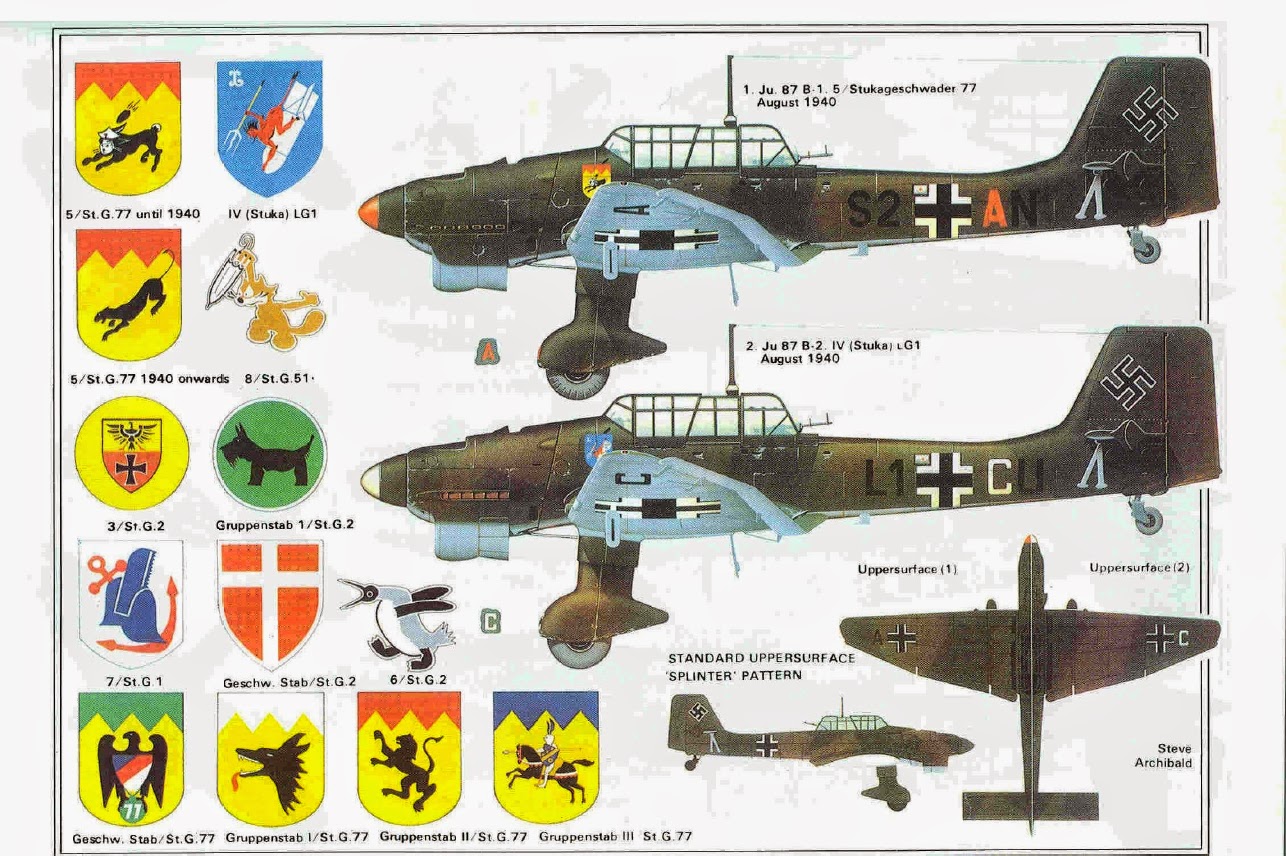
Markings were used so that aircraft could
be identified. Just like camouflage, the subject of Luftwaffe airplane markings
is complex and rather confusing. When one observes markings used on German
aircraft, one is immediately struck by the number of variations from 1935 to
1945. This section merely gives a general outline of markings intended to be
applied.
National
markings
From 1933 to 1935, Germany did not
officially possess an air force, but the nazification of the civilian airfleet
was evident by a replica of the Nazi flag painted on both sides of aircraft
fins. This consisted of a bright red band with a white circle in which there
was a black Hakenkreuz (swastika), very often standing on one point to
emphasize an impression of dynamism and movement. In early 1936, a series of
changes came into force. These included the application of the Balkenkreuz
(national cross), a Greek cross with four arms of equal length. This was black
with white outline similar to that used on German tanks. The Balkenkreuz was placed
on both sides of an aircraft's fuselage at midpoint between the wing and tail
units. It was also painted on the wings, both on upper and undersurface. This
emphasized the importance of identifying friend and foe in a campaign where
close cooperation between ground-attack aircraft and dive bombers and the
assaulting armored forces was a fundamental feature of the Blitzkrieg.
The aircraft of the German Legion Condor
that took part in the Spanish Civil War were repainted, as Germany was not
officially at war against the Spanish Republic. Instead of Balkenkreuz and
Hakenkreuz, they carried a white Andrea's cross in a black circle on both sides
of the fuselage, while fins and rudders had a black Andrea's cross on a white
background. The conspicuous red/white/black swastika painted on fins and
rudders was discarded and replaced in late 1938 by a simple black swastika,
often with a thin white outline. In the case of ambulance airplanes, the black
and white Balkenkreuz was replaced by a red cross on a circular white
background. Later in the war, there were several variations on the Balkenkreuz
theme. For camouflage purposes, the cross was often merely outlined in white or
black with the center left in the basic color.
Tactical
markings
Tactical markings enabled a unit commander
to quickly call up one of his aircraft by radio and pick it out more easily
above the battlefield. Before the official creation of the Luftwaffe in 1935,
German airplanes had no tactical markings but a civilian registration,
generally a letter D for Deutschand (Germany) and a sequence of three of four
letters. After 1935 identification marks were introduced, consisting of a
combination of three letters and an Arabic numeral applied on the fuselage, in
conjunction with the Balkenkreuz, the cross dividing the four symbols. These
codes were painted in such as way that they would be readable if the aircraft
was passing over the observer from front to back. These markings represented
the plane's Geschwader, Gruppe and Staffel. The expansion of the German air
force in the years preceding the war required some administrative changes, particularly
when the Luftflotten (air fleets) were created in 1939. Single-engine fighter
units had their own marking system, showing unit and tactical seniority. These
used chevrons to indicate the rank of the pilot; bars, points or cross to
indicate the Gruppe; a numeral showing the Geschwader to which the Gruppe
belonged; and sometimes a horizontal black line ran entirely around the
fuselage indicating a staff pilot. A Geschwader commander, for example, was
indicated by two chevrons and a vertical bar; a Gruppe commander by two chevrons;
a Gruppe technical officer by a chevron and a small circle. Colors were also
applied to indicate the Geschwader; they were also designated by their
abbreviation followed by an Arabic numeral: e. g. KG 77, NJG 26, ZG 110.
Staffeln in the Geschwader were numbered consecutively in Arabic numerals; the
first, second, and third Staffeln constituted Gruppe I; the fourth, fifth and
sixth Staffeln, Gruppe II; and the seventh, eighth and ninth Staffeln, Gruppe
III. Where a fourth or fifth Gruppe existed, the Staffeln were numbered 10, 11,
and 13 or 13, 14 and 15 respectively. In unit designations, the Gruppe numeral
was omitted whenever the Staffel number was displayed. Thus the fourth Staffel
of Kampfgeschwader 77 was known as 4/KG 77 and no other reference to its
position in Gruppe II of KG 77 was necessary. Gruppen attached to a Geschwader
were numbered in Roman numerals; thus I/KG 77 and II/KG 77 were the first and
second Gruppen of the medium-range bomber Geschwader 77.
Training aircraft were indicated by letter
S for Schule (school), a numeral indicating Luftkreis, a letter identifying the
school, and the aircraft's registration numeral within the school. There were,
however, many exceptions to the rules, and systems were partially changed,
becoming complicated. As World War II progressed, the application of the rules
became somewhat more lax, and interpretation at the unit level varied widely
from front to front and year to year, resulting in a complex and confusing
"system" without uniformity, markings being omitted, some obscure or
rarely seen, others added or placed in unofficial positions. Geschwader
designations could then consist of three digits, and a system of colors was
introduced to indicate Staffeln and Gruppen. There were many variations on the
theme, some being in solid or outlined form, or red, yellow, white or black
according to the plane background color. In 1941, colored tail bands were added
according to theater of operation, and often wingtips and cowling were painted
in the same color. In mid-1944, a more complicated system of colored tail bands
was introduced for fighter units in the defense of the Reich, adding to the
confusing situation already existing. At unit level, however, the tendency was
toward smaller and less conspicuous application of the tactical numbers, and in
many cases they were simply omitted.
Next to each of the airplane's filler
points, there was a small yellow triangle pointing upward, bearing indications
referring to the octane rating of the fuel. Luftwaffe vehicles were marked with
an identification plate bearing the prefix WL (Wehrmacht Luftwaffe).
Unit
and individual emblems
Individual pilots and those belonging to an
established unit had "honor titles," crests and emblems. This
practice, started by prominent flyers and units of World War I, such as the
famous "Red Baron," Manfred von Richthofen, was revived in the
Luftwaffe, and awarded, for example, to fighter JG 132. The fighter Geschwader
JG 26 was titled Leo Schlageter, after a Nazi activist, an early "martyr"
of the cause shot down by the French in 1923. Another example is JG 134, which
was named Horst Wessel after the Nazi Party's gutter poet, and distinguished by
its brown, the color of the early Nazi and Sturm Abteilung (SA, Storm Trooper)
uniforms.
Insignia were of great variety. Directly
inspired by classical heraldry, they represented the arms of the city or cities
with which the pilot or units were associated, or were individual devices with
geometrical forms including colored triangles and diamonds. Pseudoheraldic
signs such as birds (eagle, owl and raven), and other animals (shark, lion,
cat, horse, fox, unicorn, even Walt Disney's Mickey Mouse) were frequently
used. Some crests were obviously directed at a particular target. Example of
this type were the cliffs of Dover, an axe cleaving John Bull's hat, or a dog
performing on a puddle-shaped map of England. Numerous other examples were
observed, using various aggressive combinations and martial themes, for
example, lightning, a falling bomb, a flying devil, and Death with its scythe.
The shark's mouth insignia with menacing teeth was also used; it displayed unit
heraldry, suggesting personal flamboyance and enhancement of aggressive spirit.
It was painted, for example, on Messerschmitt Bf 109C of 2/JG 71, Junkers Ju 87
B-1 Stuka of 2/StG 77, Messerschmitt Bf 110 C of II/ZG 76 (Haifisch Gruppe) and
even on Gotha Go 242 gliders. Individual, personal or unit good-luck symbols
were sometimes used. Crests, insignia and emblems were usually placed on both
sides of the cowling near the cockpit or on the aircraft's nose. The kill tally
was proudly exhibited in the form of small stars or bars, generally painted on
the aircraft rudder. Art and decoration painted on aircraft in the form of
pin-ups, fictional or cartoon heroes, lucky or aggressive symbols, animals, and
patriotic motifs were often disapproved or frowned upon by military
authorities, but they were often tolerated as they benefited morale, expressed
individual pride, offered relief from uniform military anonymity, comforted by
recalling home, and were believed to work as fetishes against enemy action.
Thursday, February 19, 2015


Subscribe to:
Posts (Atom)