Showing posts with label Pilots. Show all posts
Showing posts with label Pilots. Show all posts
Tuesday, March 10, 2015
Bloody foreigners. Untold Battle of Britain
This dramatised documentary recounts how, during the most decisive phase of the Battle of the Britain, a single squadron of 34 Polish fighter pilots wreaked havoc on the Luftwaffe, in the process helping to change the course of history and overturning RAF prejudices.
From 303 Squadron's bitter struggle for acceptance when they first arrived in the UK, to the crucial part they played in averting the German invasion, and their ultimate betrayal by the Allies, this unknown story is one of the most extraordinary episodes of World War II.

BBC South East's Robin Gibson chats to Squadron Leader Mahinder Singh Pujji in the summer 2010.
LINK
Squadron Leader Mahinder Singh Pujji was the last surviving fighter pilot from a group of 24 Indians who arrived in Britain in 1940.
The Gravesend man has died aged 92 after a stroke.
Sq Ldr Pujji, who learned to fly as a hobby in India, sailed to England after reading an advert in a newspaper. He warned his family he might never return.
The group were invited to tea by the Royal family at Windsor Castle as a thank you for their willingness to risk their lives. Within a year, 12 of the Indian pilots had been killed.
He began training in the autumn of 1940 and early the next year began flying Hurricanes protecting coastal convoys and intercepting bombers and fighters when Hitler ordered the bombing of London in the Blitz.
He survived several crashes and flew combat missions throughout the war in Britain, Europe, North Africa, the Middle East and Burma and was awarded the Distinguished Flying Cross.
After the war he became a champion air race pilot in India, and set endurance records in gliders. He even flew the first Indian prime minster Jawaharlal Nehru in his glider.
Fleet Air Arm pilots

Four of the 58 Fleet Air Arm pilots who flew with RAF Fighter Command during the Battle of Britain achieved unofficial 'ace' status for five confirmed aerial victories that summer; these are two of them - SILts R. J. Cork and A. G. Blake, who were both awarded the DSC. 'Dickie' Cork
(left) flew Hurricanes in No. 242 Sqn led by Douglas Bader, and Arthur 'Admiral' Blake (right) flew Spitfires with No. 19 Sqn; Blake scored four solo kills and one shared before he was shot down and killed on 29 October. Note the naval pilot's 'wings' badge, worn above the rank stripe on the left cuff only of the No. 5 Dress jacket.
While battles were fought in the seas, skies and fields of Norway, the British Expeditionary Force had also been locked in combat against German Army Group A in Belgium and France. The Allied forces failed to repulse the German mechanized offensive, and the decision was taken to evacuate the BEF. Between 22 May and 4 June more than 330,000 Allied soldiers were evacuated from the beaches of Dunkirk during Operation 'Dynamo', by an armada of military and civil shipping, and the already thinly stretched Fleet Air Arm was committed alongside the RAF to provide air cover. Skuas were involved in air-to-air combat over the beaches and the English Channel, protecting ships from German bombers and also flying alongside Albacores to attack German ground forces. Remarkably, FAA student pilots flying tiny Tiger Moth training biplanes were also used to drop off food and medical supplies for the troops waiting on the beaches.
With German forces now occupying Norway and the whole northern coast of NW Europe much of the UK was within range of aerial assault. While the Battle of Britain raged in the skies of England during the summer of 1940, two Fleet Air Arm squadrons - 804 and 808 NAS, flying Sea Gladiators and Fulmars respectively - operated under the control of the RAF's 13 Group in the north of England and Scotland. A further 58 FAA pilots were temporarily attached to RAF fighter squadrons during the Battle; 18 of them were killed in action, and 12 made claims. Four naval fighter pilots - SILts A. G. Blake, RJ. Cork, F. Dawson-Paul and R. E. Gardner - each scored at least five confirmed aerial kills during that summer.
Theo Osterkamp


Adolf Galland far left, Theo Osterkamp second from
the right, Werner Mölders on far right.
At the end of July, 1940 at age 48, later Generalleutnant
Theo Osterkamp was officially ordered to cease combat flying. Since the
formation of JG 51 in 1939 (which he commanded), he had flown constantly, and
added 6 more victories to his World War One score(32 WWI). He received the
Knight's Cross in August of 1940 to go along with his Pour le Mérite...
In World War II he led Jagdgeschwader 51 through the Battle
of Britain and claimed a further 6 victories, in the process becoming one of
only a few men to score victories in both World Wars!
On 19 September 1939 Oberst Osterkamp was appointed
Geschwaderkommodore of Jagdgeschwader 51 (JG 51). During the Battle of France
he claimed four victories, the first on 12 May 1940. During the Kanalkampf
period of the Battle of Britain he claimed a further two victories, bringing
his total to six...
In the end, Theo Osterkamp was credited with 38 victories.
He recorded 32 victories during World War 1. He recorded two confirmed and at
least four unconfirmed victories in World War 2, all claimed over the Western
front...
Here is the data of his air victory in World War II :
1. 12 May 1940 against Fokker G-1 at Soesterburg : confirmed
2. 22 May 1940 against Hurricane at Roubaix : not confirmed
3. 31 May 1940 against Hurricane at Dunkirk : not confirmed
4. 1 June 1940 against Blenheim at Dunkirk : not confirmed
5. 13 July 1940 against Spitfire at Dover : not confirmed
6. 13 July 1940 against Spitfire at Dover : confirmed
WWII Indian flying ace Squadron Leader Pujji, 92, dies

Squadron Leader Mahinder Singh Pujji was awarded the Distinguished Flying Cross for bravery.
An Indian pilot who flew Hawker Hurricanes during World War II has died, it has been announced.
Squadron Leader Mahinder Singh Pujji, 92, died at at Darent Valley Hospital in Kent on Saturday following a stroke.Sqn Ldr Pujji was believed to be the last surviving fighter pilot from a group of 24 Indians who arrived in Britain in 1940.
He survived several crashes and was awarded the Distinguished Flying Cross for services in Burma.
Wartime experiences
Sqn Ldr Pujji also flew combat missions in Britain, Europe, North Africa and the Middle East during the war.
Earlier this year he published a book about his wartimes experiences entitled, For King and Another Country.
Following the war Sqn Ldr Pujji became a champion air race pilot in India setting endurance records in gliders.
He later settled in Gravesend in Kent.
Josef František – a Czech in a Polish Squadron

His
Hurricanes
Sergeant Josef František DFM* (7 October 1914, Otaslavice - 8
October 1940) was a Czechoslovak fighter pilot and World War Two
flying ace. He flew for the air forces of Czechoslovakia, Poland
and the United Kingdom. He is famous as being the number one allied
ace in the Battle of Britain.
Sergeant Josef František DFM* (7 October 1914, Otaslavice -
8 October 1940) was a Czechoslovak fighter pilot and World War Two flying ace.
He flew for the air forces of Czechoslovakia, Poland and the United Kingdom. He
is famous as being the number one allied ace in the Battle of Britain.
Born in Otaslavice in 1913, Josef František joined the
Czechoslovak Air Force in 1934. After basic training he joined the Czechoslovak
Air Force Air Regiment 2. In 1935 he was a Corporal in Air Regiment 1 and
returned to Air Regiment 2 as a Sergeant in 1937. In June 1938 he became a
fighter pilot serving in the 40th squadron in Prague flying the Avia B-534 and
Bk-534 fighter. After Czechoslovakia fell under German occupation (15 March
1939) like many other Czechoslovak airmen he escaped to Poland. Most
Czechoslovak airmen then left Poland for France before the start of the Second
World War, though František decided to stay and serve with the Polish Air
Force.
During the German invasion of Poland in September 1939,
František initially evacuated training aircraft from the air base at Dęblin.
From 7 September he flew reconnaissance missions in an unarmed training plane,
a RWD-8. On 19–20 September he attacked enemy columns near Kamionka Strumiłowa,
throwing hand grenades on the troops below. On 20 September he was shot down
near Złoczów, but was saved by a Polish crew that landed nearby. On 22
September František's unit was ordered to withdraw with their remaining
aircraft to Romania. František managed to abscond from an internment camp in
Romania and reached France via North Africa in October 1939.
In France František elected to remain with the Poles instead
of joining the exiled Czechoslovak air force (a probable reason for this
decision was a conflict with a Czech officer, who tried to arrest him for
insubordination.)
There are no official French records to confirm he flew
during the Battle of France, but several witnesses claim he downed 7 to 11
German planes and damaged more while serving in France under a different name.
There may have been an identity confusion and may he have been mistaken for ace
František Peřina. František himself claimed to have joined Armee de l'Air and
scored 11 victories, receiving the customary Croix de Guerre for his first
air-to-air victory.
After the fall of France František fled to Britain and after
training on 2 August was assigned to No. 303 Polish Squadron based in Northolt,
flying Hawker Hurricane fighters. The squadron entered action in the last phase
of the Battle of Britain. The first confirmed victory of Sgt. František was a
German Bf 109E fighter on 2 September 1940.
A very ill-disciplined pilot, he was seen by his commanding
officers as a danger to his colleagues when flying in formation. His British CO
Squadron LeaderR. Kellett, offered to arrange for František's transfer to a
Czech squadron, but František preferred to stay and fight alongside his Polish
colleagues. As all pilots were valuable, a compromise was created whereby
František was allotted a "spare" aircraft so he could fly as a
"guest" of the Squadron as and when he wanted to. Thus, František
fought his own private war - accompanying the squadron into the air, but
peeling off to fly a lone patrol over Kent, patrolling in the area through
which he knew the German aircraft being intercepted would fly on their way back
to base, possibly damaged and low on fuel and ammo. During the following month
he shot down 17 German aircraft and 1 probable, of which 9 were Bf 109s,
becoming one of the top scoring Allied fighter pilots of the Battle of Britain.
His last victory was on 30 September 1940 and he was awarded the Distinguished
Flying Medal.
On 8 October 1940, František's Hurricane crashed in Ewell,
Surrey during a landing approach after a patrol. Reasons for the crash are not
known, but according to some theories, he may have been making aerobatic
figures to impress his girlfriend, or it might have been a result of battle
fatigue and physical exhaustion.
He was buried in a Polish military cemetery. He was awarded
several decorations, among them the Virtuti Militari 5th class and he was the
first foreigner awarded the Distinguished Flying Medal with Bar.
The Airmen's Stories - F/O J E Storrar
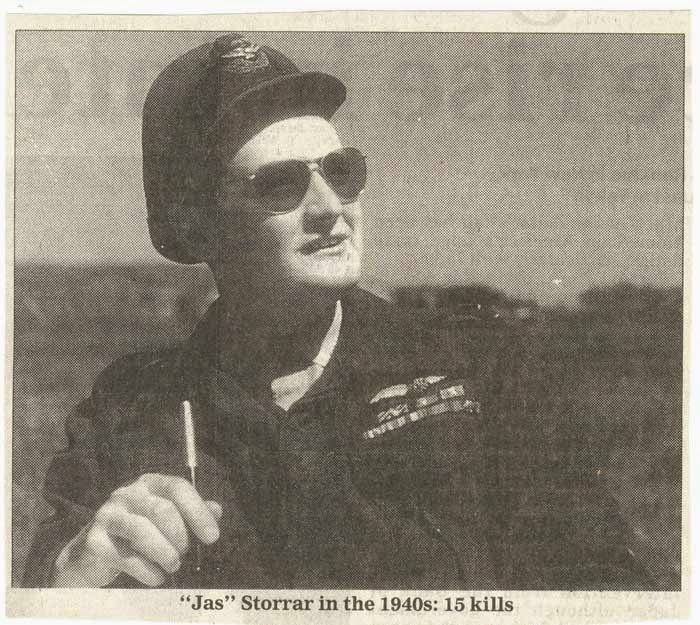
Wing Commander
(Flying Officer during the Battle) James Storrar, who has died aged 74,
notched up 15 confirmed kills as a Hurricane pilot during the Battle of
Britain.
"Jas" Storrar, as he was always known, was a teenager when war broke out. He immediately volunteered for the RAF and flew missions to protect the troops of the BEF as they were being evacuated from the beaches of Dunkirk. By mid-August of 1940, Storrar had already been credited with nine kills and was a relative veteran when Germany launched its massive bombing raids on Britain.
At first, seeing so many German aircraft filling the sky I thought we must lose the war he recalled. As the battle escalated Storrar, flying with No 145 Squadron, was often compelled to "scramble" three times before tea. On his third sortie one summer's day he found himself flying alongside a Ju87 Stuka.
I could quite clearly see the pilot looking at me. I could see his hand on the stick Storrar later said. He sent the Stuka blazing into the sea. That day No 145 was credited with 25 kills but lost six of their own.
I looked no further than breakfast the next day, of having a cup of tea and offering up a silent prayer. When we lost six pilots I didn't think of them. I thought of me. As long as it wasn't me it didn't matter.
James Eric Storrar was born at Ormskirk on June 24 1920. His family had run a veterinary practice at Chester since the early 18th century and he was educated at Chester City and County School. In October 1938 he joined the RAF on a short service commission. The next year he was posted to No 145, then flying Blenheim bombers from Croydon. In March 1940 the Squadron converted to Hurricanes. After the Battle of Britain, the depleted squadron was sent to Drem in Scotland to rest and re-form and Storrar served briefly with 421 Flight, a specialised interception unit, before moving to No 73, another Hurricane squadron. In November 1940 the squadron sailed to Takoradi on the coast of West Africa, aboard the aircraft carrier ‘Furious’. It then flew the "stepping stone" route across Africa to Egypt. After a brief detachment to No 274 the pilots returned to their own unit.
On April 4 1941, Storrar spotted a Lockheed Lodestar which had made a forced landing in the desert. He put down and discovered the Lodestar was General Wavell's personal aircraft. After Storrar had helped the Lodestar's pilot to get his engine going, he found that his own aircraft would not start. He was obliged to walk across the desert to Tobruk. A few days later Storrar was enjoying a rest at Takoradi when he was asked to ferry a Hurricane to Freetown. Bad weather forced him down in the jungle; it took him two days and three nights to walk more than 70 miles to the Firestone rubber plantation near Monrovia. In 1943 he returned to Britain. Aged 22, he received command of No 65, a Spitfire squadron flying bomber escorts and fighter sweeps over France and the Low Countries.
In the course of a screaming dive on a Me109 Storrar overstressed his Spitfire which had to be written-off after landing. The next year he moved to a Transport Command unit flying an air delivery service, but returned to operations in the autumn of 1944 as commander of No 64. He later commanded Nos 165 and 234 squadrons and in 1946 was posted to Italy to command No 239 Wing, equipped with Mustangs.
The next year Storrar was offered an extended commission. He opted instead to study veterinary science at Edinburgh University and later joined the family practice. In 1949 he joined No 603, a Royal Auxiliary Air Force squadron and resumed flying. He went on to command No 610, the County of Chester Auxiliary Squadron.
Storrar was awarded the DFC in 1940, a Bar in 1943.
"Jas" Storrar was a giant of a man. Well over 6ft tall, he was barely able to squeeze into the cockpit of his fighter. Over the years he retained something of the flamboyant style of a Battle of Britain pilot. His jackets were lined with red silk and his Jaguar XJS 12 bore the registration JAS.
He was married, and had three sons and a daughter.
Stanislaw Skalski and His "African Circus".

Stanislaw Skalski was born on 27 October 1915 in the country
village of Kodyma. Completing Pilot Training School in 1938, Stanislaw was
ordered to the 142nd Fighter Squadron in Torun. On 1 September 1939 he downed a
German Hs 126 reconnaissance aircraft at 5:32 a.m (after his own interview's
relation). A note of interest - - if Wladyslaw Gnys had not destroyed two
Do-17s at 5:30 a.m. (as some sources claim), but instead at 7:00 a.m. (as Gnys
himself reported), this would mean, that Skalski scored the FIRST victory of
WWII! In September 1939, Skalski reached "ace status", by personally
downing 6 German aircraft (1 Ju 86, 2 Do 17, 1 Ju 87, 2 Hs 126), plus 1 Hs 126
shared with another pilot. Furthermore, he damaged another three planes (1 Bf
109, 1 Hs 126, 1 Ju 87). Skalski flew his last sortie with his P-11c on 16
September. The next day he fled the country, as did several other Polish
pilots, to Rumania, and from there to fight in France and England.
On 12 August 1940, 2/Lt Skalski joined 501st Squadron RAF
(commander S/Ldr H.A.V. Hogan) and took part in the "Battle of
Britain". Stanislaw Skalski's part in the combat of 5 September 1940, was
very dramatic. Early in the morning, 501 Squadron took off to attack a large
group of German aircraft. In first attack Skalski managed to hit a He 111
bomber, and set its right engine on fire. Following this, the Polish pilot shot
down one of the escorting Bf 109s. The pilot of the Bf 109 bailed out. A few
minutes later, as Skalski flew alone at 8000 meters altitude, he made a
surprise attack on another Messerschmitt. With success! But in turning to his
map to note the area of the victory, his own aircraft was hit by a well-aimed
burst of fire. The shells slammed into the fuel tanks and the
"Hurricane" immediately caught fire. Skalski bailed out from his
diving fighter and parachuted to the ground. Severe burns kept him in a
hospital for six weeks. During the Battle of Britain, Skalski shot down a total
of six German planes.
Following the combat death of Capt. Ozyra on 29 April 1942
(in the same battle, Maj. Marian Pisarek was also killed), Capt. Skalski was
given the command of the Polish 317 Squadron for five months. On 1 October 1942
317 Sqn was given a new commander, Capt. Zbigniew Czajkowski, and Skalski's
African career began.
The Polish Fighting Team (PFT), popularly called
"Skalski's Circus", was made up of the best Polish fighter pilots.
All fifteen of them volunteered and Capt. Stanislaw Skalski was their
commander. After a month’s transition, the Polish pilots arrived at Bu Grara
airfield (250 km west of Tripoli) on 13 March 1943. They at first became part
of 145 RAF Squadron (commanded by S/Ldr Lance Wade) as the "C"
Flight. The call code of 145 Squadron was "ZX" and the aircraft of
the Polish Flight received the individual code numbers "1" to
"9".
Operational duty for the PFT began 17 March 1943. The first
combat missions were in "Spitfire" Mk Vc trop fighters, but after a
week the unit was re-equipped with new "Spitfire" Mk IX (while other
flights of the 145th still flew the Mk V!). On 28 March 1943, the PFT drew its first
blood. The flight led by Skalski encountered a group of Ju 88's escorted by Bf
109Gs of II./JG 77. No fighter planes were shot down on either side, but
Skalski and Lt. Horbaczewski claimed killings of two Ju 88s.
On 2 April 1943, four Polish "Spitfire" pilots
from 145 Squadron attacked 16 Bf 109s of II./JG 77 and claimed three
Messerschmitt 109s shot down, one of them by Skalski. The record of II./JG 77
'Herzas' shows: the Bf 109s attacked a formation of Douglas Bostons escorted by
"Spitfires", and Feldwebel Alexander Preinfalk claimed one Boston
shot down (his 64th victory). Oberleutnant Heinz Dudeck's Bf 109 G-6 was the
only German loss. Dudeck belly-landed and escaped the wreck unhurt. He was
taken care of by some local Tunisians who fed him milk and ten raw eggs! On the
Polish side the "Spitfire" piloted by Lt. Arct was damaged, but he
was able return to base.
Two days later, the Polish fighters attacked a group of Ju
88s accompanied by Bf 109s. The German escort prevented them from attacking the
bombers, but Skalski and Capt. Krol each downed one Bf 109. Lt. Martel claimed
one 109 damaged. Next day, Lt. Horbaczewski scored a single Bf 109, but his
"Spitfire" was heavily damaged on the mission. On the afternoon of 6
April, Lt. Sporny and Sgt. Malinowski destroyed two Bf 109s.
On 18 April 1943, the Polish Team of 145 Sqn ('C' Flight)
sustained its only loss, as F/Lt Wyszkowski, lagging behind a formation, was
bounced from the sun by a Messerschmitt Bf 109 - Rotte of 7./JG 53 'Pik As'.
Unteroffizier Georg Amon shot down the "Spitfire". Wyszkowski
crash-landed in enemy territory and was taken prisoner by the Germans. This was
AmonŤs first victory. Two months later (on 25 June 1943, vividly accounted in
Johannes Steinhoff's book 'Die Strasse von Messina'), when JG 53 was based in
Sicily, the Luftwaffe's Fighter General Adolf Galland (visiting Sicily at that
time) personally ordered Amon to be court-martialled for 'cowardness'; Galland
claimed that Amon had deliberately turned away from combat to avoid
confrontation with B-17s. However, the general confusion on Sicily at that time
saved Amon from the court-martial. With a total of nine victories, Amon was
shot down by AA over Germany on 2 April 1945 and was taken prisoner by the
Allies.
On 20 April 1943, the "Spitfires" of 145 Squadron
made a surprise attack on a mixed formation of German and Italian fighters and
claimed to have shot down nine, of which the Polish pilots claimed three Bf
109s and three Macchi Mc-202 "Folgores". That day, I. and II./JG 53
'Pik As' lost a total of five Bf 109 Gs in aerial combat. At least one -
piloted by Leutnant Rolf Schlegel - was shot down by Spitfires.
On 22 April 1943, the entire 244 Fighter Wing with 145
Squadron acting as top cover attacked a formation of six-engine Me 323 Gigant
of TG 5 escorted by Italian fighters and the Messerschmitt 109s of JG 27, JG 53
and JG 77. The P-40s of 7 Wing, SAAF, also took part in the attack, claiming
the destruction of 31 Me 323s! Transportgeschwader 5 lost sixteen Me 323s. The
Polish fighter pilots, led by F/Lt. Pniak, engaged the escort and claimed five
Bf 109s and one Mc-202 shot down. In II./JG 27, three Bf 109s were lost:
Leutnant Schlechter was shot down over sea and was saved by air-sea rescue,
while Feldwebel Rudolf Lenz and Unteroffizier Heinz Golletz were missing. The
only claims by II./JG 27 were made by Leutnant Schneider - two P-40s (his first
and only victories in the war). JG 53 'Pik As' had one Bf 109 shot down:
Leutnant Friedrich Fiebig of 6. Staffel bailed out with injuries. I./JG 77 'Herzas'
suffered no losses, while one of its pilots - Leutnant Heinz-Edgar Berres
claimed one "Spitfire" (his 43rd victory).
On 6 May 1943, "Skalski Circus" fought its last
aerial combat. On this occasion, Skalski and Sgt. Sztramko downed 2 Bf 109s. On
13 May 1943 the war in Africa was over. During two months, the Polish pilots
had shot down a total of 26 German and Italian planes. Capt. Skalski scored 4
aircraft, but the most successful of the unit had been Lt. Eugeniusz
Horbaczewski been, with 5 confirmed victories.
After the Flight was disbanded, Capt. Skalski did not leave
this theatre of war. As commander of 601 Squadron RAF "County of
London", he took part in the invasions of Sicily and Italy. He returned to
England in the end of 1943.
During period 13 December 1943 - 3 April 1944, Major Skalski
commanded the 131 Fighter Wing (Polish Squadrons: 302nd, 308th, 317th, till
October 15th, 1944 - Ist Polish Fighter Wing). On 4 April 1944 (remaining in
this position until 3 August 1944) he was appointed commander of the other
Polish Fighter Wing - the 133th (Polish Squadrons: 306th, 315th and British
129th). On 24 June 1944 Skalski, leaded the whole Wing, scored two air
victories in a battle over Rouen. Altogether, Polish fighters claimed 6-1-4 enemy
planes in this action, but unfortunately they lost Sgt. Adamiak from the 315th
Squadron, when his "Mustang", FZ157, crashed in the St. Croix/Beaux
area (north-west of Dreux).
Stanislaw Skalski was the most successful Polish ace of WW
II, with a record of 22 confirmed victories, 1 probable, and 1 damaged enemy
aircraft. Three times he was awarded the British DFC, and he received many
other medals. Following his return to Poland after the war, he was imprisoned
by the Communist regime in 1949, on a charge of espionage for the West. He
spent 6 long years in a jail, waiting for execution. That was his
"reward" from the communists, a fate he shared with many other Polish
soldiers returning from the West for their heroic and sacrificing duty. In
1956, Skalski was finally released from prison.
Subscribe to:
Posts (Atom)